STUDIO GHIBLI FILM CONCERT TOUR FINAL
Music composed and conducted by Joe Hisaishi
Performed by the Royal Philharmonic Orchestra
Concertmaster (Violin soloist): Duncan Riddell
Soprano: Ella Taylor
Vocalist: Mai Fujisawa
Mandolin: Marie Burou
Featuring the choral talents of:
– The Philharmonic Chorus of Tokyo
– Brooklyn Youth Chorus
– Little Carol
Featuring the military marching bands:
– Japan Ground Self-Defense Force Eastern Army Band
– Japan Ground Self-Defense Force 1st Band
– Japan Ground Self-Defense Force Tokyo Band
– Japan Ground Self-Defense Force Central Band
– Japan Ground Self-Defense Force Central Air Band
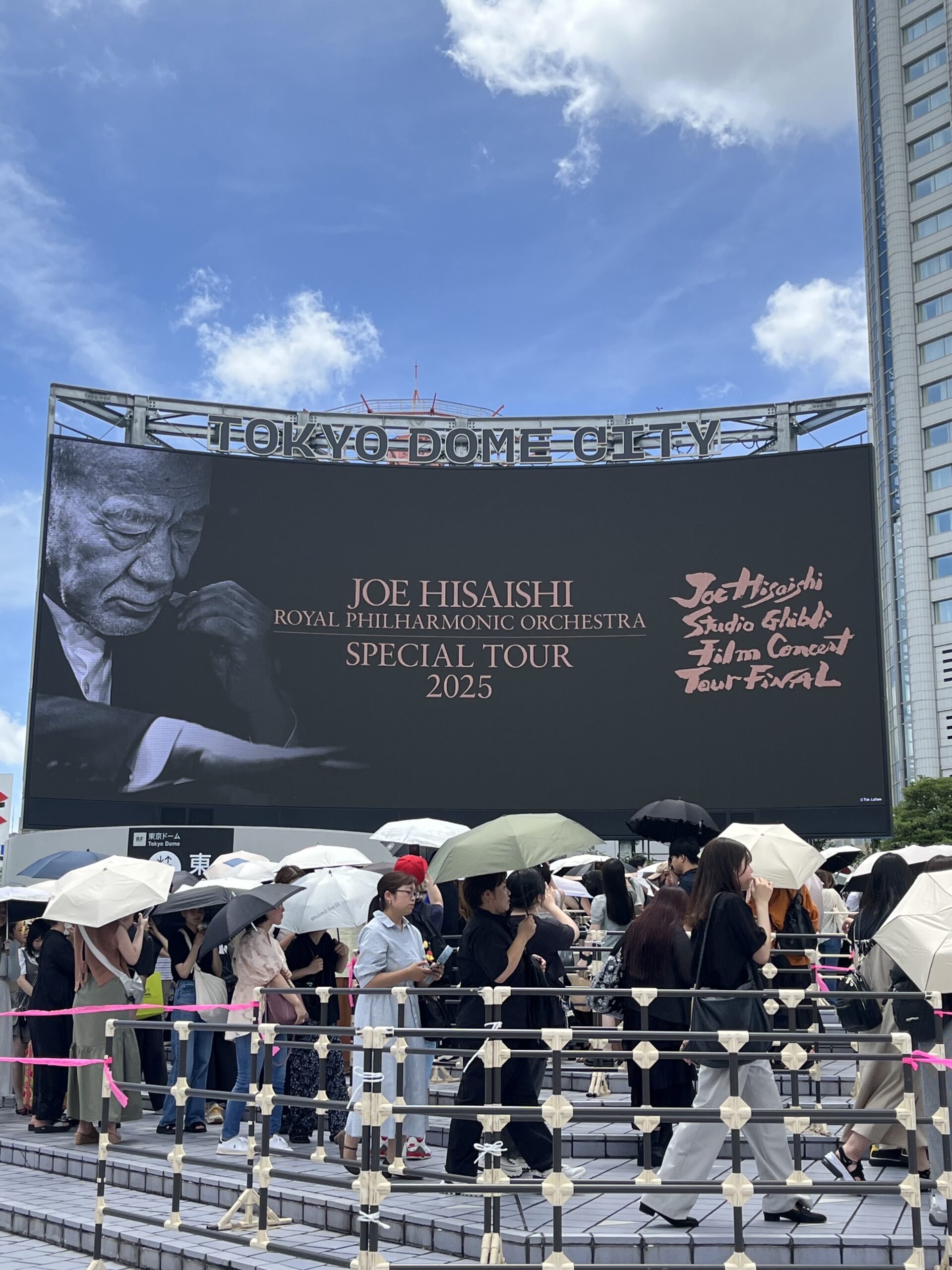
July 17, 2025
Tokyo Dome
Tokyo, Japan
PART 1: A 17-YEAR WAIT
It was almost seventeen years ago that Joe Hisaishi had last conducted a concert of his most beloved music for the films of Studio Ghibli in his homeland of Japan.
As you can imagine, as soon as it was announced earlier this year that he’d be playing Tokyo Dome this July in a concert billed “Studio Ghibli Film Concert Tour Final,” anticipation for the event had understandably hit intense highs.

But the sad reality is that many missed out on getting a ticket. In fact, many didn’t even have a fair chance.
Tickets were originally sold via lottery with the majority of fans losing out. A second lottery was then held that again left many disappointed. And by the time general sales opened not long after, it became apparent that “true” fans had slim chances of ever getting a ticket – and how do I know this? A quick scan of X and other third-party ticketing websites clearly showed that the majority of tickets were being bought up by scalpers who were reselling those tickets at over ten times their original price.
It was not uncommon to read about feelings of anger and utter devastation across various social media platforms about not being able to get tickets to see what was for many a lifelong dream.
This tidal wave of complaints and despair caught the attention of Hisaishi and the concert organizers who then decided to add a matinee performance on the second and final day.
It is for this added performance that I could FINALLY get a ticket through the first round lottery. However, despite paying for a top-tier ticket and being seated in the corner of the very last row of the arena, I really couldn’t complain because I could at least get a ticket.
PART 2: THE BEST OF THE BEST
Performed without intermission, “Studio Ghibli Film Concert Tour Final” saw Joe Hisaishi conduct the Royal Philharmonic Orchestra through a program of his most beloved hits for the films of Studio Ghibli starting from NAUSICAÄ OF THE VALLEY OF THE WIND to the 2023 Academy Award-winning animated film, THE BOY AND THE HERON.

Supplementing the orchestra throughout the program were full adult and youth choirs as well as five military marching band regiments for the CASTLE IN THE SKY suite.
The setlist for the concert was as follows:

The orchestra and choir arrangements were largely identical to the pieces contained on the best-selling album, JOE HISAISHI: A SYMPHONIC CELEBRATION, with vocal solos and choir parts sung in English, Japanese or Latin.


PART 3: SOUND AND TRANSLATION
You’d be hard pressed finding anyone that attended any one of the three performances that was disappointed with the superlative performances by the musicians and guest performers.
But that’s not to say that the concerts were without fault.
There were certainly sound amplification issues from time to time, and this may well be due to the sheer size of Tokyo Dome which is more popularly known as a venue for baseball games and high profile pop music concerts.

As an example, there were times that the choir was amplified too loudly or intricate details in the orchestration were barely audible. Again, this may well be because of the venue’s size or where I was sitting.
In any case, perhaps the biggest issue for many was the lack of Japanese translations.
For a concert held in Japan to a predominantly Japanese audience, how could this possibly be?
Every piece containing choir or vocals had their lyrics shown on the large overhead screens. When pieces were sung in Japanese, their English translation appeared on screen. But when a handful of songs were performed in English, only English text was projected on screen – inexplicably, their Japanese translations were missing. As a native English speaker, this wasn’t a problem for me. But for tens of thousands of Japanese fans in Tokyo Dome, it most probably was.
Despite the issues outlined above, nothing can take away from the fact that it was still a monumental concert that will be remembered for many years to come by the legions of Hisaishi/Ghibli fans that were actually able to get a ticket.
PART 4: A PRE-CONCERT VIDEO
Before the concert proper, a ten-minute montage of nature and background shots from various Studio Ghibli films were projected on screen as pre-recorded music for piano and other instruments was played on the loudspeakers.
The music was calm and soothing, complimenting the shots of forests, trees and rocks projected on screen.

But to be honest, I couldn’t quite place the music – was it actually composed by Hisaishi? And if so, for what film was it composed for? The music did not bear any of Hisaishi’s typical stylistic hallmarks, so I just couldn’t be sure.
Reports online would suggest that this music was indeed written by Hisaishi for an installation in the famed Ghibli Museum in Tokyo, a place I last visited some twenty years ago on a failed date!
PART 5: THE MAIN PROGRAM
NAUSICAÄ OF THE VALLEY OF THE WIND
– The Legend of the Wind (piano: Joe Hisaishi)
– Nausicaä Requiem
– The Battle between Mehve and Corvette
– The Distant Days
– The Bird Man

An instantly recognizable 5-note statement on the timpani marked the beginning of a tremendous suite of music from NAUSICAÄ. Strings and brass then joined, giving way to what many had been waiting for: Hisaishi moving from the conductor’s podium to the Steinway to play that iconic piano statement of the film’s opening theme.
The “Nausicaä Requiem” came next, with the adult choir powerfully chanting the Latin words which were projected without translation on screen.
Chase and battle music followed, creating a strong sense of excitement and danger.
I had been wondering who would be performing the instantly recognisable “la la la-la la la la” of “The Distant Days,” but it soon became apparent as the Brooklyn Youth Chorus took the spotlight to perform the melody. This soon gave way to the spectacular entry of the adult choir for a spine-tingling performance of “The Bird Man.”
We then returned to the opening music one more glorious time before building up to a wildly satisfying climax to end the suite.
KIKI’S DELIVERY SERVICE
– A Town with an Ocean View
– Heartbroken Kiki
– Mother’s Broom (violin: Duncan Riddell)

It was impossible to not smile and cry during this gorgeous suite of music from KIKI’S DELIVERY SERVICE.
While it was wonderful to hear “A Town with an Ocean View,” which perfectly captured the mischievous, carefree and optimistic attitude of the film’s protagonist, seeing Hisaishi grin and bounce his body while conducting the pizzicato string part of the piece was even better.
This was soon followed by a spirited theme on cellos with tambourines and other percussion instruments providing rhythmic support.
The mood was then contrasted by “Heartbroken Kiki,” a short and melancholy piece underscoring Kiki’s loss of ability to fly. Coupled with scenes from the film projected on screen, it was hard not to shed a tear.
Then came one of my favourite pieces of the entire concert, “Mother’s Broom,” a stupendous piece for solo violin and orchestra.
Duncan Riddell, who is concertmaster of the Royal Philharmonic, elicited enormous emotion with his impassioned violin solo. Unlike previous recordings of the theme, his performance sounded loose and warm, perfectly hugging the contours of the orchestra.
So taken was I by his performance of Hisaishi’s gorgeous theme that I totally forgot how hot it had gotten in the auditorium – I had pretty much been holding my breath during the entire piece, savouring each musical phrase, and reminding myself of how lucky I was to be there.
In any case, I’m certain I wasn’t the only one swooning in the audience as the piece soared and came to a conclusion.
(Riddell really should have been spotlighted as one of the soloists in the concert program – he more than deserved it!)
PRINCESS MONONOKE
– The Legend of Ashitaka
– The Demon God
– Princess Mononoke (soprano: Ella Taylor)

The powerful beats of a bass drum opened the epic “The Legend of Ashitaka” from PRINCESS MONONOKE.
Ominous music then followed as the film’s main theme began to take shape. Choir soon burst into the piece – amped a bit too loudly I might add – to raise the epic level to 11.
The frantic “The Demon God” came next with the percussion section and adult choirs working overtime in sync with scenes of the Demon God attacking the village.
Panic then gave way to tranquility with the angelic “Princess Mononoke.” Sung in Japanese with perfect pronunciation by soprano Ella Taylor, their performance had the perfect amount of reverence and beauty, and had me in absolute raptures as they sung in counterpoint to the choir during the piece’s transcendent climax.
THE WIND RISES
Featuring Marie Burou on mandolin
– A Journey (A Dream of Flight) (piano: Joe Hisaishi)
– Nahoko (The Encounter)
– A Journey (A Kingdom of Dreams)

Featuring a nostalgic melody loaded with European charm, the suite from THE WIND RISES showcased the tremendous talents of famed mandolin player Marie Burou.
In the first piece, “A Dream of Flight,” Burou immediately captured our hearts with her flawless performance of the lovely main theme with Hisaishi himself accompanying her on the piano.
Smiling throughout, Burou was clearly enjoying herself, and she more than expressed this in her passionate performance of the music.
Next came some music with whimsy and charm in that inimitable Hisaishi style. The piece certainly has echoes of some of the fanciful moments in Hisaishi’s score for PORCO ROSSO, which also happens to be my favorite score of his.
“The Encounter” soon followed with a short piece laced with sentimentality.
For “A Kingdom of Dreams,” we were treated to a fine orchestral arrangement of the opening theme. While the mandolin was not used during this short piece, I just love how it fleshed out the opening theme and gave it a more traditional classical feel.
The stately “A Kingdom of Dreams” came next with a reprise of that whimsical theme.
The suite then came to an end with a welcome return to the mandolin theme for a perfect fairytale-like ending.
PONYO ON THE CLIFF BY THE SEA
– Deep Sea Pastures
– Mother Sea (soprano: Ella Taylor)
– Ponyo’s Sisters Lend a Hand – A Song for Mothers and the Sea
– Ponyo on the Cliff by the Sea

Expertly evoking the wonders and grandness of the ocean, “Deep Sea Pastures” kicked off a glorious suite of music from PONYO ON THE CLIFF BY THE SEA.
A quick statement of the main PONYO theme came next, followed by a superlative performance of “Mother Sea” by soprano Ella Taylor. Sung in Japanese, the piece held us in a warm and loving embrace as their voice rose in climax towards sheer ecstasy.
The sensational action set piece “Ponyo’s Sisters Lend a Hand” was then performed, reminding us how good Hisaishi is at writing exciting and visceral action music.
After a quick reprise of the “Mother Sea” theme, the suite concluded with an orchestra and choir arrangement of “Ponyo on the Cliff by the Sea.”
If I have to be completely honest here, I don’t think the English lyrics lend themselves well to this piece. In addition to being a bit on the nose, some of the word choices just don’t sound smooth when being sung.
I actually wish the piece had instead been performed in its original Japanese by its original performers like at the last Hisaishi/Ghibili concert in 2008. And like that concert, it would have brought the house down if the audience was given sheet music to joyously sing along.
CASTLE IN THE SKY
Featuring Choirs and the Japan Ground Self-Defense Force Marching Bands
– Doves and the Boy
– Carrying You
– The Eternal Tree of Life

As the suite from PONYO was coming to an end, we were all distracted by the sudden appearance of military marching bands lining the aisles of the arena in preparation for the next suite of music from CASTLE IN THE SKY.
When PONYO finally ended, the orchestra members walked off the stage as the marching bands began to perform “Doves and the Boy,” a regal melody that seemed destined to be played by marching bands.
The iconic “Carrying You” came next accompanied by the Brooklyn Youth Chorus who took on the instantly recognisable opening melody in Japanese. Adult choirs then entered to give the piece weight, with the marching bands soon following to ramp up the growing sense of anticipation and call to action in the music.
With choirs and marching bands coming together in time for the huge climax, you couldn’t help but be impressed by how well executed the piece was given the size of the arena and distance between the marching bands and its conductor who had been positioned in the middle of the large arena floor.
The suite ended with a lovely band and choir arrangement of “The Eternal Tree of Life,” a piece perfectly capturing the growing solidarity felt by the film’s protagonists.
PORCO ROSSO
Bygone Days (piano: Joe Hisaishi)

My favourite ever Hisaishi score was represented by the short but sweet “Bygone Days” from PORCO ROSSO. Based on the anime film’s timeless love theme for Marco and Gina, this small ensemble arrangement was evocative of rowdy late night jazz bars.
The piece started with Hisaishi at the piano as the ensemble members – that included trombones, a tuba, two clarinet players and one bass clarinet – snapped their fingers to the beat.
Trombones soon joined Hisaishi to give the piece an infectious swagger, with clarinets later joining the party to provide some wicked improv. Before I knew it, I was swaying to the music – I’m certain I wasn’t the only one.
HOWL’S MOVING CASTLE
Symphonic Variation «Merry-go-round + Cave of Mind» (piano: Joe Hisaishi)

HOWL’S MOVING CASTLE was represented with a lengthy and spectacular suite of music that traversed a sea of emotions.
While the “Merry-go-round” part of the suite featured clever variations and fragments of the waltz theme, I remember being particularly impressed by the perfection at which the orchestra took on some of the busier and more challenging parts of the suite.
Another standout moment in this first part was a short, but utterly gorgeous pastoral section that I only wish had been longer.
A solitary trumpet then signaled the beginning of the transcendent “Cave of Mind,” a piece that just kept building and building until it exploded with emotion. Coupled with some of the most touching moments from the film projected on screen, you couldn’t help but be totally overwhelmed.
But the suite wasn’t over yet.
Hisaishi then perched himself behind the piano for a joyous solo performance of the waltz, “Merry-Go-Round of Life.” After a quick interruption by the oboe, full orchestra joined for a big and beautiful statement of the main theme that had us tapping our feet along in synch.
After one last big build up, the orchestra quickly slowed to a hugely satisfying finish.
SPIRITED AWAY
Featuring Mai Fujisawa on vocals
– One Summer’s Day (The Name of Life) (piano: Joe Hisaishi)
– Reprise

Could there be anything more touching than seeing Hisaishi and his daughter, Mai Fujisawa, performing together on stage?
Gracing the stage in flowing silver robes, Fujisawa immediately entranced with the iconic “la la la la la la la laa la la” from “One Summer’s Day” as Hisaishi provided delicate piano accompaniment. As the piece continued, she began singing the Japanese lyrics of “The Name of Life,” the official vocal version of “One Summer’s Day.”
Fujisawa’s delivery here sounded somewhat different from past recordings in that her live performance this time had a looser and somewhat dreamier sound, which I think was just perfect for this melody.
“Reprise” was also sung in Japanese and had a lovely call and response structure between Fujisawa and Hisaishi at the piano. Again, Fujisawa’s vocals sounded dreamier because of her unique delivery and how her voice was amplified in the hall.
While it was lovely and emotional performance, I must say that I prefer the purely orchestral arrangement of “Reprise” on the original soundtrack album. It just flows better and ends in a more satisfying way with Hisaishi’s piano carrying both the main melody and climax of the piece.
MY NEIGHBOR TOTORO
– The Path of the Wind
– Hey Let’s Go (featured vocalists: Mai Fujisawa & Ella Taylor)
– My Neighbor Totoro (featured vocalists: Mai Fujisawa & Ella Taylor; Piano: Joe Hisaishi)

It was now time for what EVERYONE had been waiting for: a suite of music from the beloved animated film, MY NEIGHBOR TOTORO.
The film and its music mean so much to so many people, so it was only natural that a suite featuring its most popular pieces would close the concert.
The enchanting “The Path of the Wind” kicked off the suite with a performance headlined by various percussion instruments.
It then transitioned to “Hey Let’s Go,” that truly iconic* piece that opens the film. In this arrangement for orchestra and choir,it started with full orchestra, with adult choirs soon entering with an English translation of the song. The melody then went through multiple variations as each section of the orchestra stood up to both play the melody and demonstrate their instruments. The piece finally ended with all instruments coming together for a huge finish.
*yes, I realized I’ve used that word over a dozen times in this review, but it’s true!
Next came the piece that I had personally been waiting to hear since the concert had first been announced: “My Neighbor Totoro.”
As soon as the high strings entered and tenderly played the TOTORO theme, I immediately started welling up because I knew my moment had come.
Double basses then played “To-to-ro, To-to-ro” as the full orchestra joined and enthusiastically powered forward. The TOTORO theme then appeared in all its glory with the choir singing the chorus in Japanese.
But the moment I had really been waiting for was just around the corner.
The arrival of a lone trumpet accompanied the slowing of the orchestra and part of the TOTORO theme being lovingly played on cellos. And that is when it happened: Hisaishi calmly went from the podium to the piano to perform the single most touching moment of the entire concert, a solo piano version of the TOTORO main theme. Despite all that had come before it, this was the only musical moment that stopped time for me and made me thank the stars for Joe Hisaishi and his timeless and superlative music.
Tears were now well and truly flowing as the choirs and guest vocalists joined to sing the chorus together towards a spectacular climax. Needless to say, it was a triumphant, inspiring and joyous way to end the TOTORO suite and the concert’s main program.
PART 6: THE ENCORES
With little time to rest after the TOTORO suite, Hisaishi sat down at the piano for one of three encores.
THE BOY AND THE HERON
Ask Me Why (for Piano and Orchestra) (piano: Joe Hisaishi)

A reflective piece full of confidence and warmth, you could hear why it was nominated for a Golden Globe Award. It only made me regret the fact that I did not get a ticket for the upcoming Japan premiere of the orchestral suite for THE BOY AND THE HERON at Suntory Hall.
PORCO ROSSO
Madness (piano: Joe Hisaishi)

An encore staple at many of Hisaishi’s past concerts, “Madness” immediately commanded attention with a blistering performance from the orchestra. It was originally used to underscore the aerial battle scenes in PORCO ROSSO and you could tell – the music was frenetic, full of danger and never let up. And with Hisaishi himself performing the “mad” piano parts, you just couldn’t go wrong.
When the piece ended with a bang, silver and gold streamers were launched over the audience, creating a sparkling blanket of light.

But the night wasn’t over yet.
PRINCESS MONONOKE
– Ashitaka and San (piano: Joe Hisaishi)

As soon as Hisaishi played those opening notes on piano, I knew we were in for one special final treat.
Full of hope and love, the music played as uplifting scenes from the finale of the film were projected on screen.
Choir also joined and sang an English translation of a lyric originally written by Mamiko Suzuki, daughter of Studio Ghibli producer Toshio Suzuki.
As the piece came to a close, a message in English – without Japanese translation – was projected on screen. It read:
I am so grateful to be here with you.
We are back together again.To my fellow music lovers,
I wish you all the health and happiness in the world.– Joe Hisaishi
And with that, the concert came to a glorious end.
PART 7: GLOBAL APPEAL
Hisaishi notes in the program booklet that over 1.2 million people applied for concert tickets with only 120,000 available seats. If this isn’t conclusive proof of the popularity and appeal of Hisaishi’s music, then I really don’t know what is.

And this appeal extends to Hisaishi himself – he comes across on stage as such a friendly and appreciative musician. Throughout the concert he could be seen flashing smiles and giving warm glances and thumbs up to members of the orchestra during and after each piece.
And when the concert finally came to end, all he did was revel in the adulation while beckoning his fellow musicians to take their bows.
It was a wonderful sight to see, made all the more special considering the fact that this was happening in his homeland where he is both revered and adored by fans both young and old.

PART 8: CONCERT MERCH
Now this is how you do concert merch sales!
A month before the concert we were given the option to pre-order concert merch online and pick it up from the concert venue at a specified time before or after the concert.

Doing this was a true life-saver as there was no waiting time from entry to pick up – the only thing that took time was the staff confirming the contents of my order.


Right next to the pre-order pick up area was a pop-up Tower Records booth selling CDs and LPs. Thinking that they would only be selling the standard fare, a little sign caught my attention: a limited edition sticker was available with every purchase.

Being the crazed collector I am, I of course picked up two records (since I already have everything else on CD!) just for those stickers:


PART 9: OTHER REVIEWS AND INFORMATION
For further reviews, pictures and all kinds of information related to this monumental concert, I highly recommend you visit this comprehensive Japanese fan site: https://hibikihajime.com/information/54350/
While the site content is written in Japanese, the level of passion and detail for all things Hisaishi at this site is simply mind-boggling! Check it out 🙂
PART 10: OVER TO YOU
Did you also go to this concert? How did you like it?
And what did you think of my report? Feel free to comment below or reach out to me directly in the “Contact Me” section.
4 thoughts on “Studio Ghibli Film Concert Tour Final (2025)”