NOTE A MARGINE
Music composed by Nicola Piovani
Piano: Nicola Piovani
Sax: Marina Cesari
Double bass: Marco Loddo
Percussion & Vibraphone: Vittorino Naso
July 25, 2025
Fortezza di Montalcino
Siena province, Italy
PART 1: THE STARS ALIGN
I first discovered the music of Nicola Piovani when I first heard his Academy Award-winning score to the film, La vita è bella. I immediately fell in love with the score’s heartwarming themes, grand waltzes, and whimsical incidental music to underscore the comical exploits of the film’s protagonist. Since then, I have gone on to collect almost all of his albums released on CD.
What I love most about Piovani’s music is his unparalleled ability to evoke a strong sense of whimsy and melancholy within the same piece of music – it’s almost as if Piovani is saying through his music that life is a lighthearted affair that can turn on a dime. Since I also hold the same belief, his music resonates with me on a much deeper and personal level.
Now, when a composer’s music touches you in that way, the only logical thing to do is seek out their concerts in order to truly feel their music first-hand in a live setting.
Fortunately, I was able to see Piovani being honoured with a Lifetime Achievement Award and concert at the 2023 edition of the World Soundtrack Awards in Gent, Belgium.

While that was a memorable concert with excellent performances by the orchestra, Piovani did not actually perform or conduct.
I’ve written about this in the past, but it bears repeating: regardless of how good the orchestra is or how well the conductor does their job, it’s just missing that something special when the actual composer is not conducting or performing their own music.
So, as you can imagine, I had been left wanting for more. MUCH more.
I’m now pleased to say that the stars aligned this year when my family happened to be holidaying in Germany when the “Jazz and Wine in Montalcino” festival was being held in nearby Italy with Piovani and his band the headline act on July 25th.

So I of course got permission from begged the missus for permission to go to which she grudgingly accepted.
PART 2: NOTES ON “NOTE A MARGINE”
Note a margine is a unique “music and talk” concert in which Piovani performs some of his most beloved music for films, the classical concert hall, and other media while providing short anecdotes about the music and how it came to be.

The music is arranged for and performed by a four-person ensemble that includes Piovani on piano, Marina Cesari on sax, Marco Loddo on double bass, and Vittorino Naso on percussion and vibraphone. The arrangements are very much in the style of the 2007 Piovani compilation album, in Quintetto – in fact, a handful of tracks on this album are performed in Note a margine.


Piovani’s anecdotes, which are both serious and amusing, are given in Italian, meaning the entire “talk” part of the concert I attended went right over my head.
While I may not have understood a word of what Piovani was saying, the audience certainly did as they were hanging onto every word and often bursting into laughter and applause.
In any case, I did understand the music, and boy, was it something.
PART 3: THE SET LIST
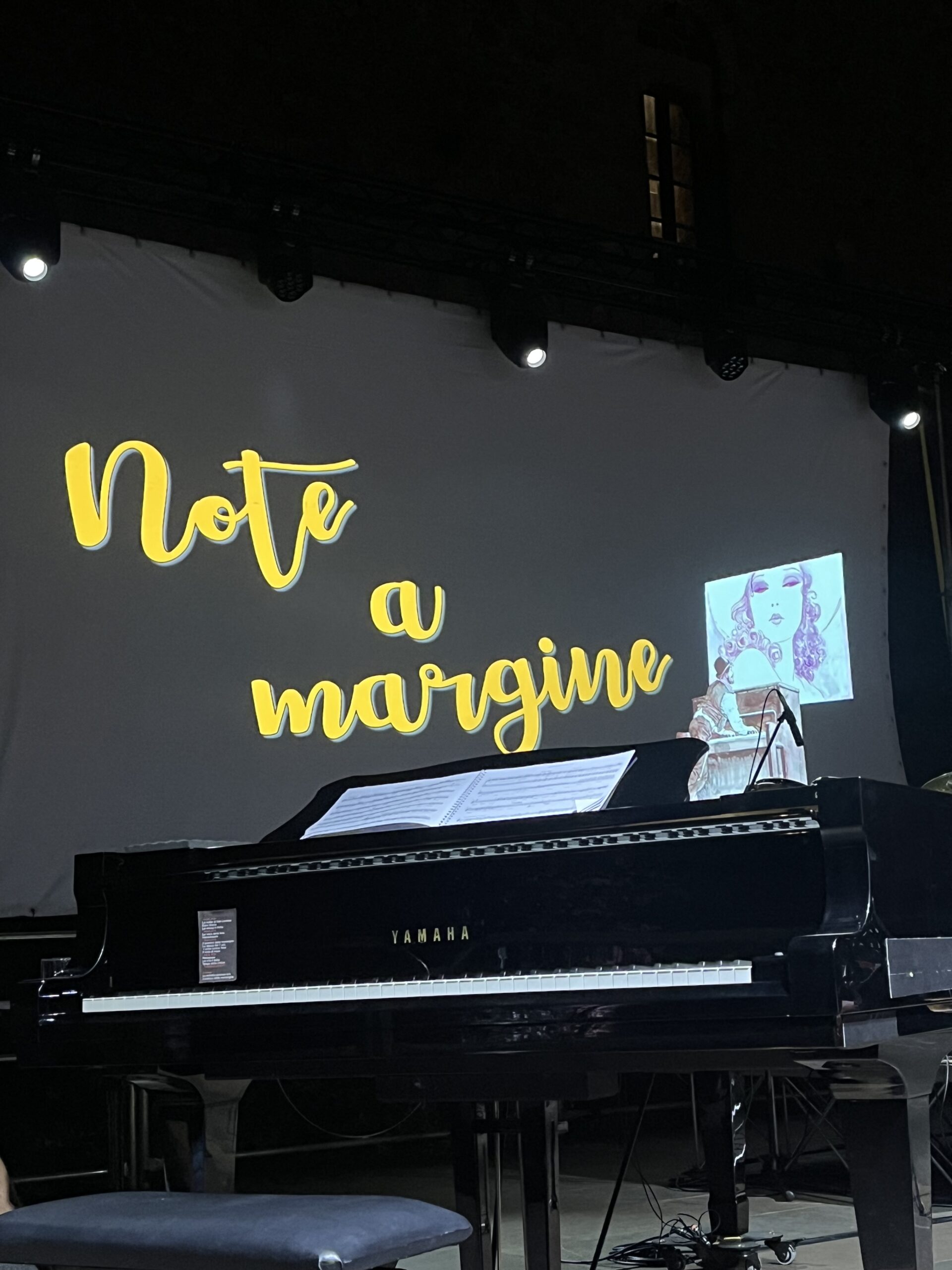
At the beginning of each piece, a title card was projected on screen followed by select scenes or images related to what it was composed for. This made compiling the below set list relatively easy:
- La Notte di San Lorenzo
- Caro Diario
- La messa è finita
- La voce della luna
- Manodopera
- Good Morning Babilonia – “Il pianino delle meraviglie”
- Epta – “La danza dei sette veli”
- Epta – “Sette contro Tebe”
- Il volo di Icaro
- Partenope
- La vita è bella
- La cimice – “Tango della Cimice”
- 1st Encore: La cimice -“La melodia sospesa”
- 2nd Encore: Good Morning Babilonia -“Il pianino delle meraviglie”
While it was a pretty decent mix of film and non-film music, I only wish some of my personal favourites had been included like Hungry hearts, Il stanza del figlio, La tigre e la neve, and Intervista… Hopefully next time 😊
PART 4: CONCERT REPORT
As mentioned earlier, Note a margine was the headline performance on July 25th at the “Jazz and Wine in Montalcino” festival held at the historic Fortezza Di Montalcino in the Siena province of Italy.

Performed without intermission, Piovani and his three-person band played under a cool breeze and rain that disappeared almost as soon as it had begun.
Gracing the stage to a hero’s welcome, Piovani made some lengthy opening remarks in his native Italian.

He then sat down at the piano to perform solo a suite of music from the critically acclaimed 1982 war fantasy, La Notte di San Lorenzo.

Piovani’s performance of that tender opening lullaby immediately pulled at the heartstrings, reminding me of how fortunate I was to be hearing it live from the hands of the man that had actually composed it.

The latter part of the suite featured some frantic action-like music with Piovani striking the piano with intense urgency.
It was an impressive suite of wide-ranging emotion, and a fantastic way to kick off the concert.
A lovely suite from Caro Diario, a 1993 Italian-French semi-autobiographical comedy film written and directed by Nanni Moretti (who also stars as himself), came next with a nostalgic piece laced with regret.

The second part of the suite featured a fun performance of the whimsical “Il Campo Di Pallone,” a piece I can only assume underscores a madcap soccer match in the film – which I have yet to see!
La messa è finita, a piece from a 1985 Moretti film about a priest that returns to his hometown of Rome after a long pilgrimage, was an arresting piece full of discomfort and tension.
Opening with choppy figures on the piano, it quickly and effectively established a sense of urgency and danger. High notes on the piano and sax gave the piece an extra edge with percussion driving the piece forward.
Another soundtrack that I adore but am yet to see the film for which it was written (yes I know, it’s Fellini and I should hang my head in shame for not having seen it yet!), La voce della luna was one of my favorite performances of the evening.

The suite kicked off with that gorgeous main theme that is full of nostalgic romanticism. Rhythmically, it sounded like a vibrant stroll, with Piovani really playing this up with his emotive and passionate playing.
Sax and vibraphone also had a part in adding to the beauty and mayhem of the piece, with double bass joining to push the beat along.
I couldn’t help but smile when Piovani later returned to the main theme for an even more spirited performance.
As I don’t watch many modern films these days – especially those without English subtitles – Manodopera (original French title: Interdit aux chiens et aux italiens) completely passed me by. In fact, I didn’t even know that Piovani had scored this comedy drama claymation film until the title card was projected on screen at the concert!
The music performed was predictably melancholy but with shades of hope in that inimitable Piovani style. It’s not one of his best, but is still worthy of a listen… and a CD release too – it is currently only available as a digital download.
The soundtrack for Good Morning Babilonia was represented with the showstopping “Il pianino delle meraviglie.”

Performed in honky-tonk style with great enthusiasm by Piovani, I couldn’t help but tap my foot along as the rest of the band joined in on the fun.
The percussion part sounded so good here – in fact, percussionist Vittorino Naso was on fire the whole evening. Despite having multiple duties on various percussion instruments, he rose to the challenge each time. I even saw him playing the vibraphone while leaning forward to play other percussion instruments at the same time!
Next came two challenging pieces from the non-film concept album, Epta.

Epta can best be described as album of orchestral suites for seven musicians performing a cycle of seven movements. The music is written with ancient and contemporary mathematics in mind, and references poetry, mythology and biblical tradition.
“La danza dei sette veli” was performed first. Inspired by the gospel story of Salome and her dance at the birthday celebration of her stepfather, who had John the Baptist beheaded at her mother’s request, it was a dark melodic work that featured difficult parts for sax, piano and percussion. Despite the morbid subject matter, it was a surprisingly memorable piece that had my foot tapping throughout.
The second piece from Epta was “Sette contro Tebe,” a much less melodic piece. Its opening had a jazz feel which only became more prominent as Marina Cesari, who was tremendous throughout the evening, came in on sax to provide some fast runs akin to improvisation, except it wasn’t – none of the seven movements of Epta feature improvisation of any kind.
The piece itself was a bit repetitive and low-key, with subtle hints of a theme appearing during brief moments. To be honest, it didn’t have much an emotional payoff – instead, I think it was more appealing from an intellectual perspective.
This was now followed by an evocative suite of music from Il volo di Icaro, a piece inspired by the Greek myth of Icarus.

Taking the lead on sax, Cesari stood up from her chair and powered through the piece to give it that obsessive quality connected with Icarus’ blind determination to escape from Crete.

Another piece taking inspiration from Greek mythology, Partenope was a musical depiction of the bewitching sirens of the sea that are feared for their death-bringing songs.

Sax led, the music was repetitive and circular, taking on the form of a dark hypnotic march through the steady beat of the percussion.
It was also the first piece of the night to spotlight some arresting solo improv by Marco Loddo on the double bass.
Without fanfare or introduction, Piovani placed his fingers over the piano keys and delicately started playing those iconic opening notes to his Academy Award-winning score, La vita è bella.

Like many in the audience, I quickly took out my phone to record this moment of pure musical beauty:
Concert: Note a margine (2025)
— soundtracks-in-concert.com (@ifmcd) July 29, 2025
Nicola Piovani performs “ La vita è bella” at the Jazz & Wine in Montalcino festival in Italy on July 25 🎶
Review: https://t.co/9iH7BGZJbN pic.twitter.com/xQDp7hfzTK
What else can be said except that there is nothing better than hearing a composer perform one of their most beloved and famous themes live at the piano – the starkness of sound and purity of emotion coming from the music are simply incomparable.
To spice up the mood, Piovani concluded the main program for the night with “Tango della cimice,” a piece inspired by the play La cimice written by Russian poet, playwright, and actor Vladimir Mayakovsky.

Dominated by piano and featuring some killer sax solos, the tango boasted a catchy recurring theme and satisfying build up towards the end of the piece.
But it wasn’t over yet.
The first encore for the night was “La melodia sospesa,” another piece from the play La cimice. It was dominated by a slow and mournful melody for soprano sax that became more positive and hopeful as it progressed. Again, Cesari stole the show with her soulful sax solos.

For the second and final encore, Piovani and his band treated us to a crowd-pleasing reprise of “Il pianino delle meraviglie” from Good Morning Babilonia.
Piovani is clearly fond of this piece and that was no more evident than his endlessly energetic performance of the main theme.
With the rest of the band joining in on the fun, we couldn’t help but clap joyously along to the beat.
It was a perfect end to the concert, and one that received a well-deserved standing ovation.

PART 5: MEETING A LEGEND
Before the concert had even started, I was already on cloud nine and the reason is simple: I had the extreme fortune of meeting Piovani earlier in the day.
The Fortezza di Montalcino, which is a tourist attraction in its own right, was open throughout the day despite there being rehearsals and stage crew setting up the chairs and doing audio tests in the courtyard.
As I arrived in Montalcino a few hours before the concert, I thought I would check out the Fortezza di Montalcino. When I walked through the gates, lo and behold, there was Piovani himself, sitting at a table being interviewed.

Surprised and full of nervous excitement, I thought I would patiently wait for the right moment to say hello and ask for a photo.
When that moment came, he pleasantly obliged 😊

I had actually written a short message of thanks in English and had it Google translated with the full intention of saying it in Italian despite never speaking Italian my whole life!
Nerves got the better of me, and all I could blurt out was “grazie (thank you)” and that I had come all the way from “Giappone (Japan)” for this concert!
He then responded with “Tokyo?” to which I responded “si” even though I don’t actually live in Tokyo!!
After he signed a CD jacket that I’d brought with me, I then shook his hand and thanked him one last time before excusing myself.

And that is the story of how I met Maestro Piovani!
PART 6: CONCERT MERCH
As it was a music and wine festival with multiple headline acts, my expectations were low that a stand-alone program for the Piovani concert would be sold.
I was proven correct as all that was sold was a festival tote bag, t-shirt and bottle opener:

A festival poster sure would have been nice!
PART 7: OVER TO YOU
Did you also go to this concert? How did you like it?
And what did you think of my report? Feel free to comment below or reach out to me directly in the “Contact Me” section.