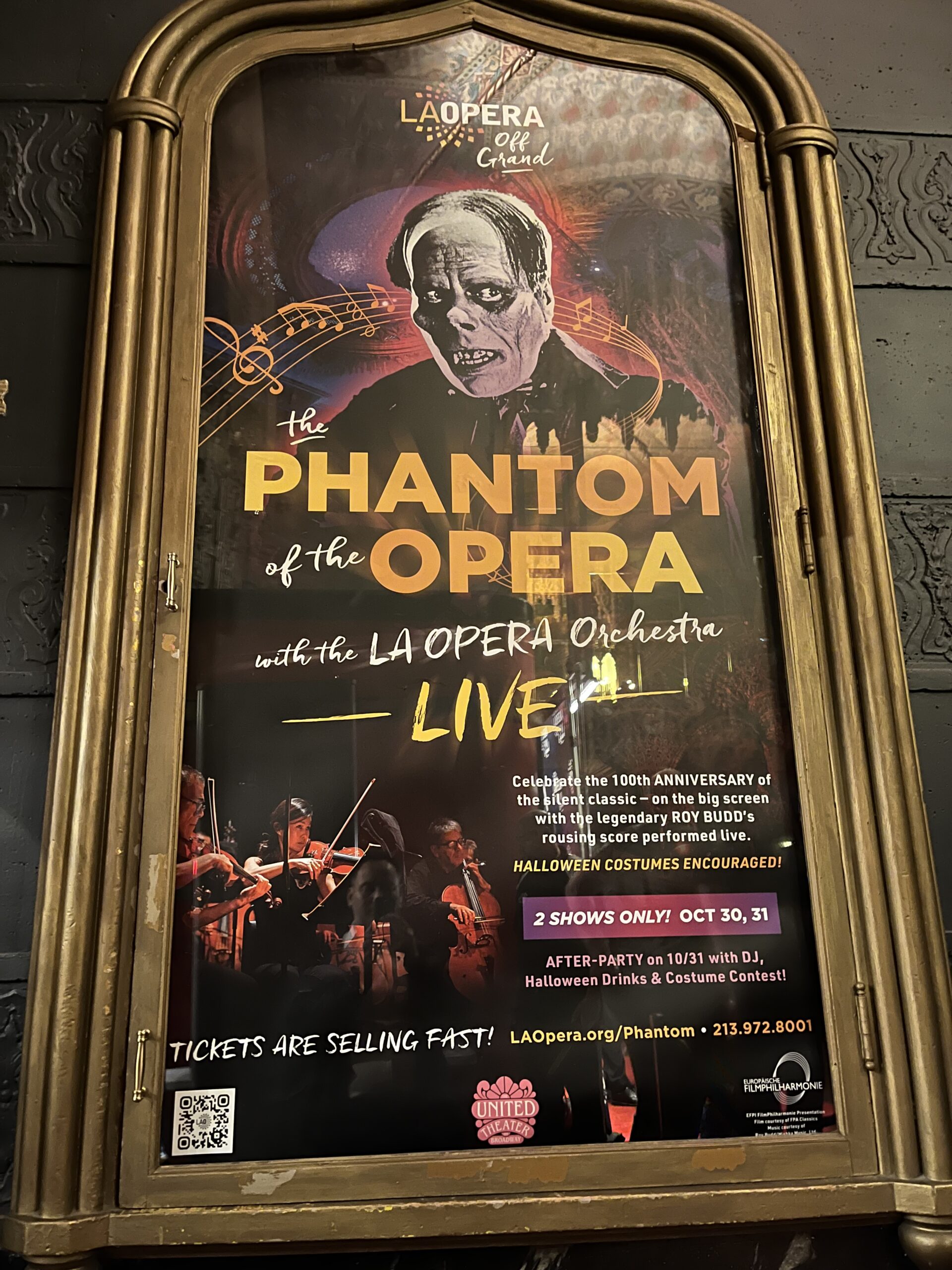
THE PHANTOM OF THE OPERA (2025)
Music composed by Roy Budd
Music conducted by Frank Strobel
Performed by the LA Opera Orchestra
October 30, 2025
The United Theater on Broadway
Los Angeles, USA
PART 1: GET BUDD
Many years ago I was at a friend’s house discussing classic film music and their composers when I casually admitted to my friend that I’d never heard any of the film music of Roy Budd.
Shocked in disbelief, he immediately put on the jazz-infused “Main Theme” from Budd’s score to GET CARTER, the 1971 gangster thriller starring Michael Caine.

To say that I was blown away is a major understatement.
Featuring harpsichord, bass, tabla drums and a killer electric piano line performed by Budd himself, it was the definition of cool and something I certainly did not expect.
Needless to say, this led me to go on and collect all of Budd’s scores that had been released commercially on CD.
PART 2: YEARS IN THE MAKING
One of his scores that had eluded me until quite recently was his music for the legendary 1925 silent horror film, THE PHANTOM OF THE OPERA, starring Lon Cheney.


Budd was a huge fan of the film and had long wished to write his own score for the film. His wishes came true and he was all set to premiere his score in concert in 1993 but tragically passed away from a brain hemorrhage just weeks before the premiere in London.
Over twenty years later, Budd’s score finally received its world premiere in 2017, and by all accounts, it was a very well-received concert and a perfect showcase of Budd’s compositional mastery.
PART 3: A LIVE-TO-FILM EXPERIENCE
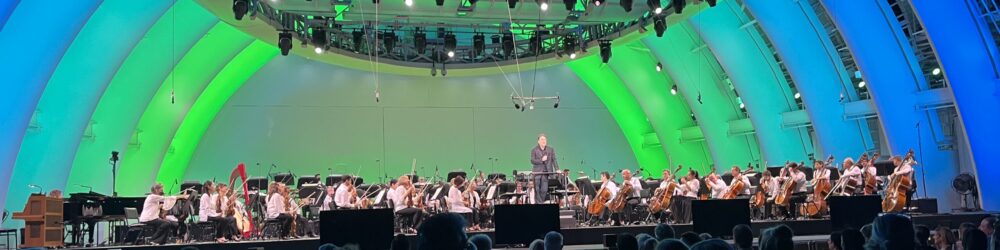
Thursday evening saw the LA Opera Orchestra perform Budd’s full score to PHANTOM OF THE OPERA live-to-film under the baton of prolific film music conductor and advocate, Frank Strobel.

The music was flawlessly performed by the orchestra with an added keyboard taking on the organ and harpsichord parts.
Regarding the film itself, I found it to be quite enthralling for the most part with its gothic imagery, opulent ballroom scenes and undeniable feelings of dread. The dialogue on the other hand is certainly a product of its time – and judging by the reactions of many in the audience, a source of unintended laughter.
PART 4: THEMES & VARIATIONS

Whatever may be said about the merits of the film itself, nothing can be disputed about the outstanding quality and emotional depth of Roy Budd’s music.
Written in a classic orchestral idiom, Budd’s score runs the gamut of emotion from creepy and tragic, to intense and full of romanticism.
He anchors these feelings with two brilliant and reoccurring themes: the “Phantom Theme” and the “Phantom’s Love Theme.” These themes go through various arrangements throughout the film depending on the mood and intent of the scene.
We first hear the “Phantom Theme” play slowly on solo organ in the opening “Overture” to evoke feelings of loneliness and tragedy. This segues into the short but gorgeous “Phantom’s Love Theme” which encapsulates the Phantom’s one-sided love for Christine, a budding opera singer in love with Raoul, a French nobleman.
The rising roll of the timpani then marks the beginning of the film as a dark and powerful arrangement of the “Phantom Theme” is played by full orchestra. Coupled with the terrifying imagery of a shadowy presence in the background, I couldn’t help but smile – this was film and music at its very best.
We then move to the magnificent Paris Opera House with a triumphant and regal theme for brass. This kicks off a lengthy and perfectly scored sequence that takes us through a ballet performance while the new owners of the Opera House discover the Phantom for the first time sitting in Box No. 5. Huge props to conductor Frank Strobel for his direction and timing of this sequence – it was done to absolute perfection and surely got the biggest applause of the night.
Prima donna Carlotta, who is instructed by the Phantom to give up her role for his love interest Christine, is given a darkly beautiful baroque theme on the harpsichord that leads into a visually stunning sequence featuring Charles Gounod’s opera FAUST.
Carlotta defies the Phantom, leading him to drop a chandelier on the audience and entrap Christine in his lair beneath the Opera House. He then asks her to think of him beyond his mask as a new and uplifting theme is performed by string orchestra with yearning French horns sounding in the background.
Later alone, Christine finds a small handwritten note from the Phantom that explicitly instructs her to never touch his mask. The sounds of a haunting solo organ piece then lead Christine into a room where she finds the Phantom playing the organ. The “Phantom Theme” follows as Christine slowly approaches and removes his mask to reveal one of the most shocking and frightening moments in the film: the Phantom’s deformed face. Budd’s music here quickly shifts gear into a state of sheer terror.
As the Phantom curses the horror of his own appearance, Christine begs him to let her go as a sign of his true love. The “Phantom’s Love Theme” then swells with passion as the Phantom gives in to her demand as long as she promises to never see her sweatheart Raoul again.
Immediately breaking her promise the next day at the Masked Ball, Christine is again kidnapped and held prisoner in his lair.
This sets off a search with Raoul and Ledoux – an undercover policeman looking for the true identity behind the Phantom – searching the catacombs and chambers beneath the Opera House. They are soon trapped in the Phantom’s torture chamber, where the Phantom proceeds to release intense heat into the chamber in an effort to kill them. Budd’s music here is ferocious, intense and highlighted by a brass-led version of the “Phantom Theme.”
The Phantom then asks Christine to decide the fate of Raoul and Ledoux as there are scenes of a wild mob on the streets heading to the Opera House in search of the Phantom.
In exchange for doing anything his heart desires, the Phantom finally decides to save the two men. Christine rushes to Raoul and holds him in a loving embrace as the Phantom looks on and Budd gives the “Phantom Theme” an arrangement full of despair then anger – the Phantom has finally lost.
The Phantom then escapes the approaching mob, forcing Christine to join him. They run out onto a street and commandeer a horse-drawn carriage as a thrilling and final arrangement of the “Phantom Theme” is performed.
The carriage crashes and the Phantom sets off on foot only to be surrounded by the angry mob who proceed to beat him to a pulp and throw him into the Seine river. The music here is neither sympathetic nor heroic – it’s full of anger and hate. The Phantom has died a monster.
And with that, the film comes to an end.
This stunning concert only served to remind us what a huge loss it was when Budd tragically passed away in 1993 at the age of forty-six. He had so much left to give and so much talent, and this is no more evident than this statement about Budd’s PHANTOM music by legendary composer John Williams: “Listen and remember that this is indeed his greatest achievement, written with compassion and nobility.”
And listen and remember we will.


PART 5: GET BUDD… AGAIN!
Relive (or live) the experience of Roy Budd’s THE PHANTOM OF THE OPERA on CD and DVD. There are a few copies on eBay and Discogs as of writing, so be quick!

PART 6: OVER TO YOU
Did you go to this concert too? How did you like it?
And what did you think of my report? Feel free to comment below or reach out to me directly in the “Contact Me” section.

It seems that you had wonderful time in Los Angeles.
I sure did! LA is the place to be for film music concerts 🙂