MY NEIGHBOUR TOTORO: THE STAGE PLAY
Music by Joe Hisaishi
Orchestrated and arranged by Will Stuart
Adapted by Tom Morton-Smith from the feature animation by Hayao Miyazaki
Directed by Phelim McDermott
Satsuki performed by Helen Chong
Mei performed by Yui Minari
Tatsuo Kusakabe (Dad) performed by Dai Tabuchi
Yasuko Kusakabe (Mum) performed by Phyllis Ho
Kaze no Koe performed by Melisa Camba
October 29, 2026
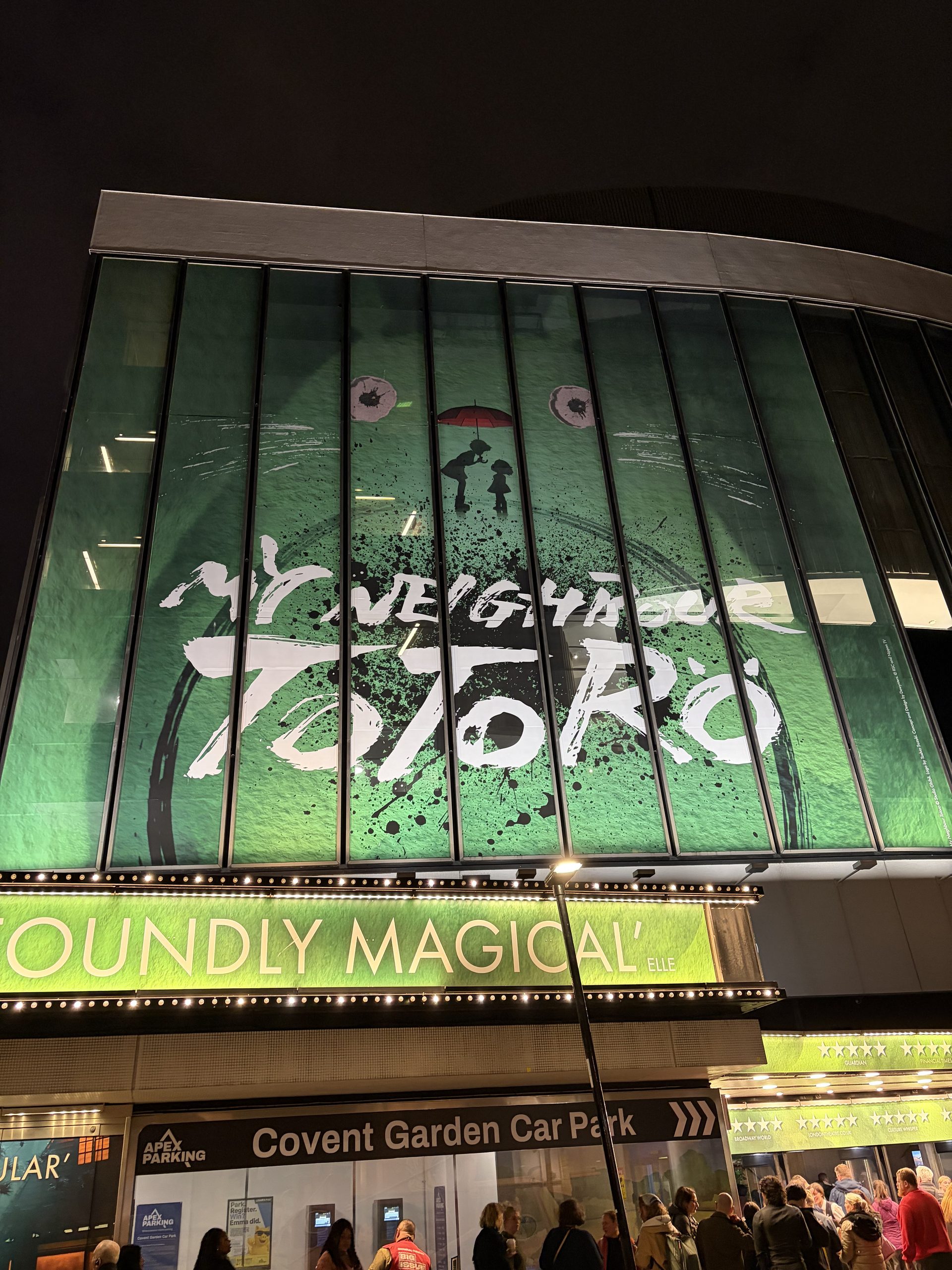
Gillian Lynne Theatre
London, England
PART 1: FROM BELOVED ANIME TO THE LONDON STAGE
MY NEIGHBOR TOTORO is the 1988 Japanese anime fantasy film written and directed by revered filmmaker, Hayao Miyazaki. It tells the story of two young sisters and their adventures with the friendly forest spirits residing near their home in the idyllic Japanese countryside.
Beloved by generations of Japanese and adored by many across the world, the animated film was finally adapted into a stage play that premiered at London’s Barbican Centre in 2022 before making its way to the West End in 2025.

The play is due to end its run in January 2027, so those wishing to see it should do so as soon as possible – it’s a dazzling production featuring stellar performances, amazing puppetry, and a truly heartwarming story.
PART 2: THE TIMELESS MUSIC OF JOE HISAISHI
Aside from its adorable characters and its timeless story of sibling conflict and love, both the screen and stage versions of MY NEIGHBOR TOROTO share one huge, Totoro-sized if you will, asset: its music.
Written by legendary Japanese composer, Joe Hisaishi, his iconic score has been expertly adapted and arranged for the stage for a handful of live musicians who perform the music from various positions above and around the stage.


The film’s most famous song, “My Neighbor Totoro – Ending Theme,” as well as the vocal versions of the score’s secondary themes, are also performed during the show by the “Kaze no Koe,” a singing narrator that appears throughout the show to heighten the mood of key scenes that have no dialogue.
For this writer, the music was the very best part of the show and something that lingered in my mind long after I went home. For that reason, this report will focus on the music and how it is used in the stage show.
Since no recording of the stage show’s music has been released, I’ll reference tracks from the multiple Totoro-related soundtrack albums out there so you can track down the music if you so please.
OST = original soundtrack album / IS = image songs album / T = track number
Without further ado, let’s get into the show I saw on October 29th and its music.
PART 3: THE FIRST HALF

Note: as pictures are not allowed during the show, please refer to the official production photos on the show’s official website for a better idea of what to expect during a performance: Gallery | My Neighbour Totoro
The iconic and joyful Totoro march (“Stroll – Opening Theme” OST T1) opens the show as the letters of “My Neighbor Totoro” move and soot sprites crawl across the blue screen via the puppeteers hiding behind the screen.
The bright and positive mood continues with the lyrics “Hey, let’s go!” sung over the “Stroll – Opening Theme” in English then Japanese. Featuring a nice part for trumpet, it is fantastic hearing live.
We then move to the countryside and the Kusakabe family, consisting of a father and his two young daughters, driving to their new home while the nostalgic and carefree “The Village in May” (OST T2) is performed by the band.
When they finally arrive at their house, we hear the ghostly “A Haunted House (OST T3),” which later becomes quite moody.
As the sisters explore the house and are about to discover the soot sprites for the first time, a mysterious and off-kilter arrangement of the Totoro theme plays (“My Neighbor Totoro – Ending Theme” OST T20). When the soot sprites finally appear and then scurry away in fright, I cannot help but chuckle when the mischievous “Traveling Soot” (IS T5) is heard complete with those short but funny sampled children’s voices (at least I think that’s what they are!).
After the family settles and goes for a soak in the bath at night, they are suddenly startled by the sound of an owl. Laughing their fears away, we then transition to the night time scene where we are treated to some gorgeous puppetry showing the soot sprites leaving the home and floating away into the moonlit sky.
The musical sequence here starts with a ghostly vocalization by the Kaze no Koe before transitioning into an unforgettable performance of “The Path of the Wind” (OST T13), one of Hisaishi’s greatest ever compositions. And when that Irish (?) whistle comes in to perform the piece’s main theme, my heart truly soars, just like those soot sprites floating away into the sky.
From memory, not a single word is spoken during this entire sequence – it’s just music and visuals all the way, lifting our imaginations and spirits to the heavens.
The next musical set piece comes as the sisters and their father visit their sick mother at the hospital. After the girls excitedly tell their mother about their new “haunted” house, the impossibly lovely “Mother” (IS T8) is performed on vocals by the Kaze no Koe. This tender and deeply emotional piece is first accompanied by piano then a gentle pop beat, perfectly capturing the scene’s underlying emotions.
We are next treated to the very first appearance of two “mini” Totoros who elicit a warm and collective “aww” from the audience. Mei, the youngest of the sisters, chases after them, leading her to a magical forested area.
Mysterious echoes of “a-ru-ko, a-ru-ko… wa-ta-shi wa gen-ki” from “Stroll – Opening Theme” (OST T1) are heard, leading to the reveal (and another wave of “aww”) of the play’s titular main character, Totoro. Manifested on stage as a huge and magnificent cuddly beast, it’s impossible to not be completely awestruck.
This spellbinding sequence is highlighted by synthesized celeste and live violin playing a beautiful lullaby arrangement of Totoro’s main theme as Mei climbs it and comfortably lies on its stomach.
When Mei later returns home and explains her magical encounter, nobody believes her – why would they?
After spending a day at school with her older sister Satsuki, they both head home in the rain and look for shelter under a roadside shrine. Here they are given an umbrella by their neighbour Kanta, who runs off in embarrassment.
The girls later go to a bus stop to wait on their father who is coming home from work. Still raining, they wait until Totoro suddenly appears to the strains of “Totoro” (OST T10) on marimba. Holding a leaf above its head to protect itself from the rain, the girls give it their umbrella, causing its eyes to light up in the most adorable way.
The iconic “Cat bus” then rolls into the bus stop with some cosmic synth sounds marking its arrival and eventual departure with Totoro in tow.
Their father’s bus finally arrives and we hear a lovely vocal performance of the iconic “My Neighbor Totoro – Ending Theme” (OST T20) with English lyrics.
Back home, the girls plant seedlings in their garden in the hope that they will grow big and tall. Despite not showing any growth, they wake up one night to find the Totoros dancing around their garden patch, causing the seedlings to sprout. After joining them in their dance, the first half of the show winds down to a close as a medium-sized Totoro doll – with tiny Satsuki and Mei figures attached – flies over and around the audience. The amusement and excitement peaks as “The Path of the Wind (OST T13)” and Totoro (OST T20) themes rise in climax.
PART 4: THE SECOND HALF
The second half kicks off in a highly amusing way: we see miniature Totoro puppets perched on a tree playing the main Totoro theme (OST T20) on woodwind instruments. What makes it a laugh is that the last note of every phrase is always off, becoming increasingly off as the melody repeats.
The girls wake up thinking the previous night’s encounter with the Totoros was all but a dream.
They then excitedly tell the neighbourhood granny that their mother is coming home for the weekend and that Mei will give her a cob of corn to help her feel better.
However, they suddenly receive a telegram asking their father to immediately contact the doctor about their mother, which puts the girls into a state of panic.
They rush off to their neighbour’s house to call their father using the only available telephone nearby. Worrying music accompanies as Satsuki explains to Mei that their mother will probably not come home this time because she needs more rest. In a fit of impatience and anger, Satsuki then screams at Mei and tells her that the corn cob she had excitedly prepared for their mother will not make her feel better. In fact, the situation is so dire that she could die!
The tone of the show now makes a marked shift, becoming dead serious with musical accompaniment all but gone.
While choking on tears, Mei screams “I hate her! She’s so mean!”
As Mei walks home alone, a heartrending arrangement of the Totoro theme plays, transitioning into an exquisite solo violin arrangement of “A Lost Child” (OST T12) as Mei has now become lost.
Urgent and worrying music follows as Satsuki searches for Mei while blaming herself for what has happened. “A Lost Child” is again performed, this time in English with heartbreaking lyrics.
As Satsuki involves the townspeople in the search for Mei and hope fades, she desperately shouts into the air, begging for Totoro to help her find her sister.
To the delight of all in the audience, Totoro appears and answers, summoning the Cat Bus to help them find Mei.
Despair turns to relief as they soon find Mei, who apologizes for running away and getting lost. The vocal version of “Stroll – Opening Theme” (OST T1) returns, this time sounding slow and gently uplifting. After Satsuki apologizes for losing her cool, the mood immediately changes as the Cat Bus theme (OST T17) plays as it prepares to fly them off to the hospital to visit their sick mother. Rolling piano, trumpet and driving percussion mark this joyous turn of events, leading to huge applause from the audience – the day is saved!
They arrive outside the hospital to find their mother and father talking to each other in the room. Not wanting to interrupt, Mei leaves her corn cob by the hospital room window with a sweet message on it: “For mummy, get well soon.”
They then return home as the show wraps up with one final spirited vocal performance of the “My Neighbor Totoro – Ending theme” (OST T20) in English as the audience joyously claps along.
The curtain call also begins, with each and every member of the cast – including the incredible talented puppeteers – coming centre stage to the sounds of thunderous applause.
And that ends an unforgettable show in the magical world of Totoro!

PART 5: THE ALBUMS OF TOTORO
As mentioned at the beginning of this report, no album recording of the music from the stage show has been released which is a terrible shame but it’s good, really good. The arrangements of Hisaishi’s iconic themes and the performances of the songs really make the show, so I do hope they release something… someday. Please!
Until then, we’ll have to make do with the various Totoro albums available commercially.
There are in fact four official Totoro music albums, two of which I referenced in my report above.
The first is the original soundtrack album, which includes the music as heard in the film:

Second is the “Image Songs,” which is essentially a concept album based on the storyboards of the film or script, often written before the film has even been shot or animated. As a result, most of it is in demo form – i.e. it’s performed by synths and uses the very bare amount of live instruments and vocals.

Next is the “Orchestra Stories” album, an orchestra and narration album that was produced by Hisaishi himself. While the narration is in Japanese only, the music is so good at telling the whole Totoro story that you just don’t need words to understand:

I was actually very fortunate to hear Hisaishi conducting his Orchestra Stories music live in concert in Tokyo some 23 years ago! Here’s my humble report on that concert: Joe Hisaishi Symphonic Special (2003) – Soundtracks in Concert
Finally is the “Sound Book,” which is the score arranged for flute, guitar, violin keyboards, and percussion.

There is actually one more Totoro album out in the wild, MEI AND THE BABY CAT BUS. Sold exclusively at the Ghibli Museum in Tokyo, it’s a short album featuring the music Hisaishi wrote for this 13-minute Ghibli short film:

If you love the music of Totoro as much as I do, it’s pretty obvious which album(s) you need: all of them 😊
PART 6: SHOW MERCH
Shut up and take my money!

The stage play venue is a Totoro merch lover’s dream! So much cool stuff on offer at not too unreasonable prices.


Fortunately, some of these items can be purchased at the official online store: My Neighbor Totoro | Official London Merchandise Store | Royal Shakespeare Company. Check it out!
PART 7: OVER TO YOU
Did you see this show too? How did you like it?
And what did you think of my report? Feel free to comment below or reach out to me directly in the “Contact Me” section.