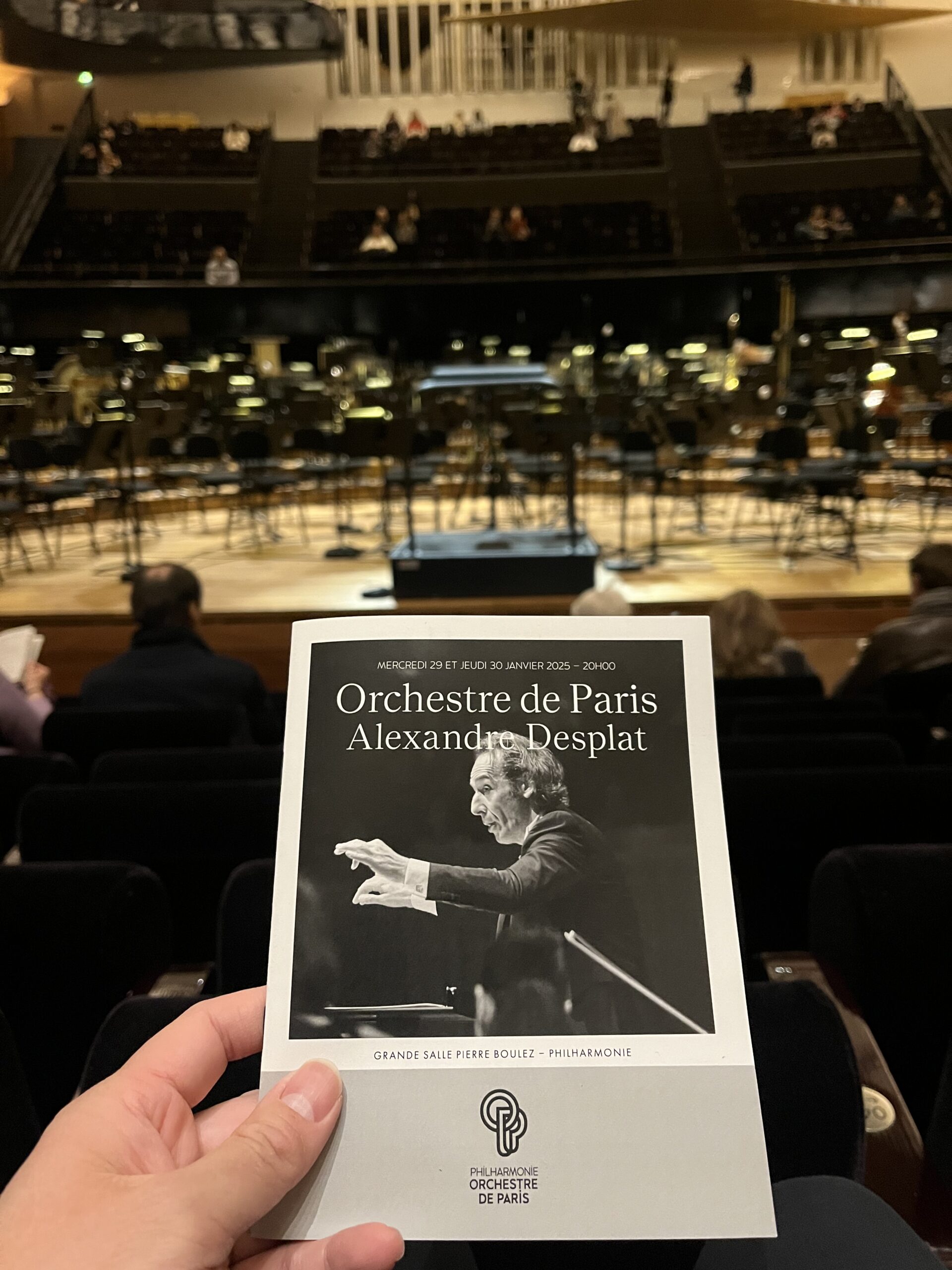
FRANCIS LAI / UN HOMME ET UNE FEMME
Music composed by Francis Lai
Conducted by Nicolas Guiraud
Performed by the Orchestre Philharmonique de Radio France
Vocalists: Anne Sila and Lambert Wilson
Piano: Randy Kerber
Electric guitar: Patrick Manouguian
Electric bass: Patrick Reveyrand
Drums: Francis Arnaud
“Hommage à Francis Lai” composed and performed by Gabriel Yared
“Melancholia” composed by Jérôme Rebotier
Special guests: Family of Francis Lai, Claude Lelouch
January 30, 2026
Maison de la Radio et de la Musique
Paris, France
PART 1: A NO-BRAINER
I found out that a Francis Lai concert would be happening in Paris only one week before it was due to be held.
Initially planning not to go as it involved a major detour from my trip to Vienna at the time, I promptly changed my mind when I saw who would be performing and premiering new music at the concert: celebrated French vocalist Anne Sila, Academy Award-winning film composer Gabriel Yared, and Jérôme Rebotier, composer of the score to the hit 2024 French film, LE COMTE DE MONTE-CRISTO.
PART 2: OVERVIEW AND SET LIST
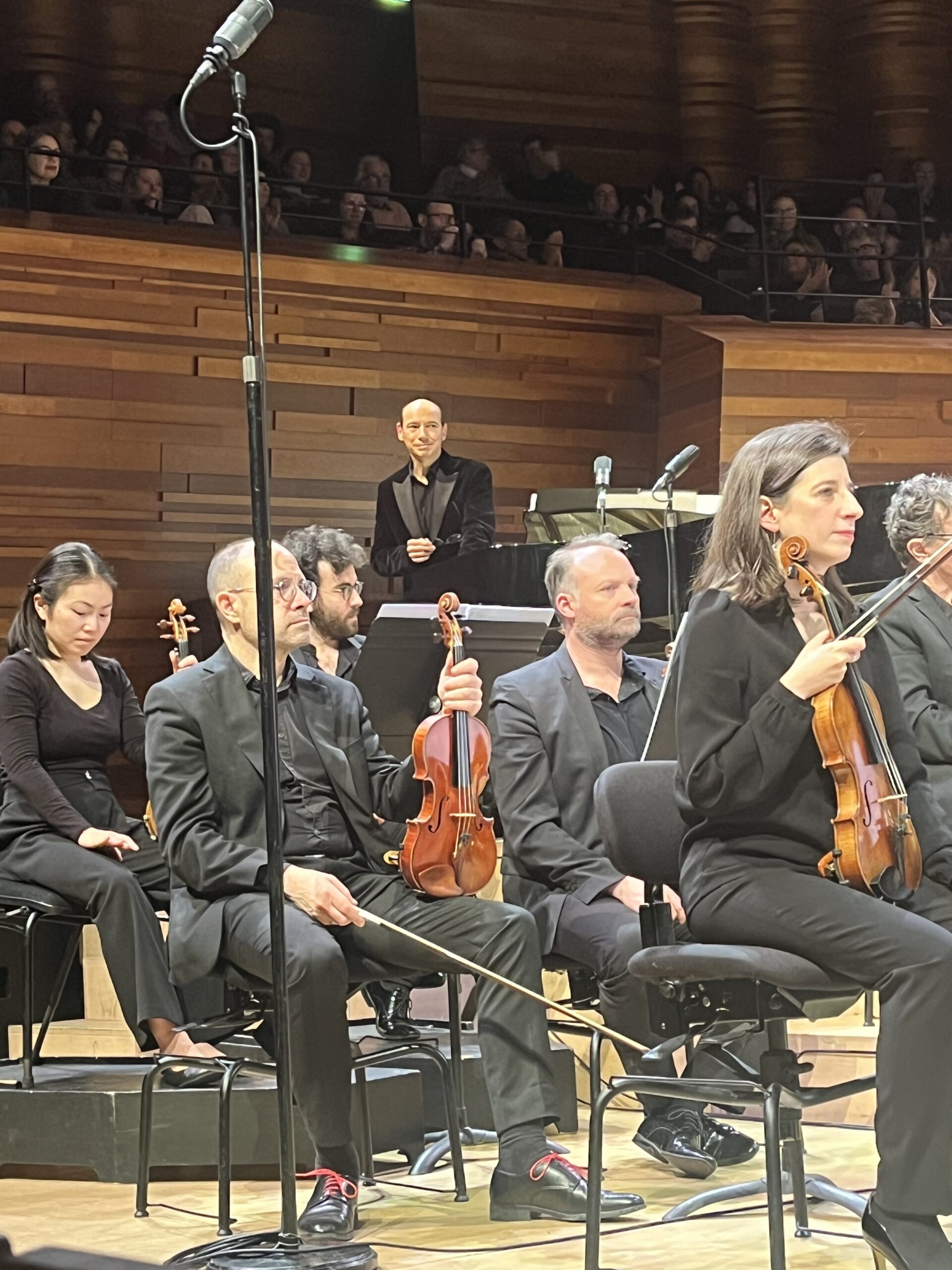
Performed without intermission by the Orchestre Philharmonique de Radio France under the baton of Nicolas Guiraud, the concert covered the biggest hits from Lai’s legendary oeuvre with a heavy focus on the music for the films of Claude Lelouch, who was also present at the concert.

Around the midpoint of the program Yared graced the stage to explain his connection to and affection for Lai and his music. He then premiered his new piece, “Hommage à Francis Lai,” which was performed by the orchestra with Yared himself at the piano.
Before the concert proper, Rebotier premiered a new work titled “Melancholia,” which he was commissioned to write by Radio France as the winner of the 3rd France Musique – SACEM Audience Award for Film Music.
The full set list for the concert can be found below:

As the majority of the concert focused on the music of Francis Lai, I’ll leave my comments about the Rebotier piece until the end.
PART 3: THE FIRST SECTION
Fortunately, the entire concert was recorded and can be found online here (audio only) and here (video), which largely negates the necessity of this review! Nevertheless, I thought it was important to share my first impressions of the music and what it was like to meet and chat to composers Yared and Rebotier before and after the concert.
I have added video time markers for your reference after each title.
Les Étoiles du cinéma
(00:28:58 – 00:30:18)
The concert kicked off with a sublime cello and acoustic guitar arrangement of “Les Étoiles du cinéma.” With the string orchestra soon joining, I couldn’t help but smile – this piece was quintessential Lai: romantic, soaring and full of joie de vivre.
Suite from Un homme qui me plait
(00:30:22 – 00:38:18)
– Poursuite western
– Concerto pour la fin d’un amour


A few select film soundbites preceded a suite of music from Claude Lelouch’s film, Un homme qui me plait (English title: LOVE IS A FUNNY THING). Powerful brass jabs opened the piece, giving way to swirling strings and an exciting western theme (“Poursuite western”).
In a shift of tone, the melancholy piano-led piece “Concerto pour la fin d’un amour” came next. As I looked over at the pianist I was surprised to see none other than Randy Kerber – legendary studio musician for many Hollywood film scores – at the keys. The piece later climaxed with a virtuosic piano take on the theme with strings swelling with longing and amour.
Treize jours en France
(00:38:34 – 00:43:12)
A Lelouch film showcasing the culture and beauty of France, “Treize jours en France (English title: 13 DAYS IN FRANCE)” immediately charmed with a piece evoking a leisurely stroll through the streets of Paris.
Truth be told, I was disappointed it was not the vocal version that I first heard performed live by Anne Sila in Tokyo a little over two years ago. That version was utterly gorgeous – luckily, it was recorded and released on CD and vinyl.


Les Yeux noirs
(00:43:28 – 00:47:11)
A romantic comedy-drama film directed by Nikita Mikhalkov, Les Yeux noirs (English title: DARK EYES) features a dark and sultry theme that is strongly reminiscent of the style of film composer, John Barry. The theme itself however is Lai through and through – it just has that pacing and sense of lyricism often associated with Barry’s music.
Itinéraire d’un enfant gâté
(00:47:25 – 00:51:56)
“Itinéraire d’un enfant gâté (English title: ITINERARY OF A SPOILED CHILD)” came next, a piece that opens with a strong sense of doom and gloom before segueing into a theme of mysteriousness and peril.
Suite from the films of René Clément:
– La Course du lièvre à travers les champs (00:52:13 – 00:55:42)
– Le Passager de la pluie (00:55:54 – 00:58:50)


Two pieces from films by René Clément followed with the first being La Course du lièvre à travers les champs (English title: AND HOPE TO DIE), a soothing and reflective orchestral piece featuring acoustic guitar, oboe, and French horn.
Waiting for her appearance all night, I was absolutely stoked when Anne Sila finally graced the stage to perform the second piece, Le Passager de la pluie (English title: RIDER ON THE RAIN).

Singing with the clarity and heart of an angel, it’s impossible to not be totally enchanted by her voice.
Les Uns et les autres
(00:59:08 – 01:02:13)

The first section concluded with Sila on vocals for the iconic Les Uns et les autres (English title: THE ONES AND THE OTHERS), a musical epic many consider to be Lelouch’s magnum opus. This pop-infused song was given a suitably energetic performance by the orchestra with Sila imbuing the song with passionate intensity.
PART 4: A HOMAGE
It was now time for Gabriel Yared to take the stage to present the world premiere of his piece, “Hommage à Francis Lai.”
Before performing the piece, Yared talked about how he first discovered Lai’s music, what he liked about his music and what he thought of Lai as a person. His full speech in French with English subtitles can be found on Yared’s Facebook page here. A video of the entire piece is included too!

Yared ended his speech with the following:
“Francis Lai always struck me as a creator who was humble, discreet, and passionate about the simple beauty of things. He was a being of innocence and at the same time of genius. Here is the tribute I wrote for him.”
And with that, Yared perched himself at the piano ready to play with the orchestra.
Hommage à Francis Lai
(01:08:11 – 01:12:17)
Yared’s “Hommage à Francis Lai” is an arresting piece for orchestra that invites interpretation and discussion.
It is not a medley of themes nor is it a work of pastiche.
Instead, it takes fragments of some of Lai’s most famous themes and invites the listener to do something with them. At first I couldn’t make sense of it, but then it soon dawned on me – we the audience had to fill in the gaps.
I doubt there is anyone in France – or the world for that matter – who does not know at least a handful of Lai’s most famous themes for the cinema. This homage obscures those themes, presenting the themes in fragments surrounded by off kilter chords and feelings of uncertainty – it then asks the listener to draw on their own memories and experiences with these melodies in order to complete them in their own minds. (Well, at least this was my interpretation of the function of this music!)
We hear bits and pieces from LOVE STORY, UN HOMME ET UNE FEMME, and LES ÉTOILES DU CINÉMA. Solo vibraphone, flute and cello take on these melodic fragments, with strings and piano providing moments of warmth but mostly uncertainty.
And then the piece comes to a sudden end with a lone piano note… inviting the listener to again determine how the music plays next.
The music is daring, arresting and open to interpretation. And I for one thought it was marvellous.
PART 5: THE SECOND SECTION
La Leçon particulière
(01:12:46 – 01:14:40)
Directed by Michel Boisrond, La Leçon particulière (English title: THE PRIVATE LESSON) is a film about a school student that falls in love with an older woman. Laced with melancholy but driven forward with a gentle pop beat, it ends with the definite feeling of tragedy.
Suite Grands espaces
– Un autre homme, une autre chance (01:14:55 – 01:18:00)
– Hasards ou coincidences (01:18:05 – 01:24:24)


Next came a pair of main themes from films directed by Lelouch: Un autre homme, une autre chance (English title: ANOTHER MAN, ANOTHER CHANCE) and Hasards ou coincidences (English title: CHANCE OR COINCIDENCE). While not Lai’s most memorable themes, they were competently performed by the orchestra, especially the piece from Hasards ou coincidences which featured lovely solos for piano and French horn.
La Bicyclette
(01:24:47 – 01:27:48)
La Bicyclette, a French song performed and popularized by Yves Montand in the late ‘60s, was then performed live by actor Lambert Wilson. When he came out on stage I knew that I’d seen him before, but just wasn’t sure where until I got back to my hotel and Googled him: of course! He was the guy that played the Merovingian in THE MATRIX films.

In any case, he immediately cast a spell over the audience with his fun and suave take on this iconic song. I couldn’t help but chuckle when he mimicked riding a bicycle just before the song began!
Bilitis
(01:28:13 – 01:32:24)
– La Campagne
– Les Deux Nudités

The suite from BILITIS, a 1977 erotic drama directed by David Hamilton, featured two highlights from the soundtrack.
The sensual “La Campagne” had a killer theme for oboe supported by a gentle pop beat. This segued into “Les Deux Nudités” with clarinet, acoustic guitar and oboe featured during the piece. I never tire of this theme – it’s mysterious, romantic, and everything in between.
Suite from Vivre pour vivre
– Thème principal (01:32:44 – 01:35:50)
– Thème de Robert (01:36:03 – 01:39:34)
Another Lelouch concoction, Vivre pour vivre (English title: LIVE FOR LIFE) features one of Lai’s very best main themes (“Thème principal”). Piano-led, the theme is light, romantic, and speaks of a simpler, carefree time.
On the other hand, “Thème de Robert” was a much more upbeat and urgent piece.
Love Story
(01:39:45 – 01:44:45)

Dang. The Orchestre Philharmonique de Radio France’s performance of the “Love Story Theme” – and especially Randy Kerber’s turn at the piano – was pure and utter ecstasy.
It’s the closest I’ve ever heard live to the original recording – Lai himself would surely have been bowled over by this superlative performance. Bravo!
Un homme et une femme
(01:45:20 – 01:48:23)

There was no doubt that the concert would end with Lai’s most famous piece, the main theme from Un homme et une femme (English title: A MAN AND A WOMAN).
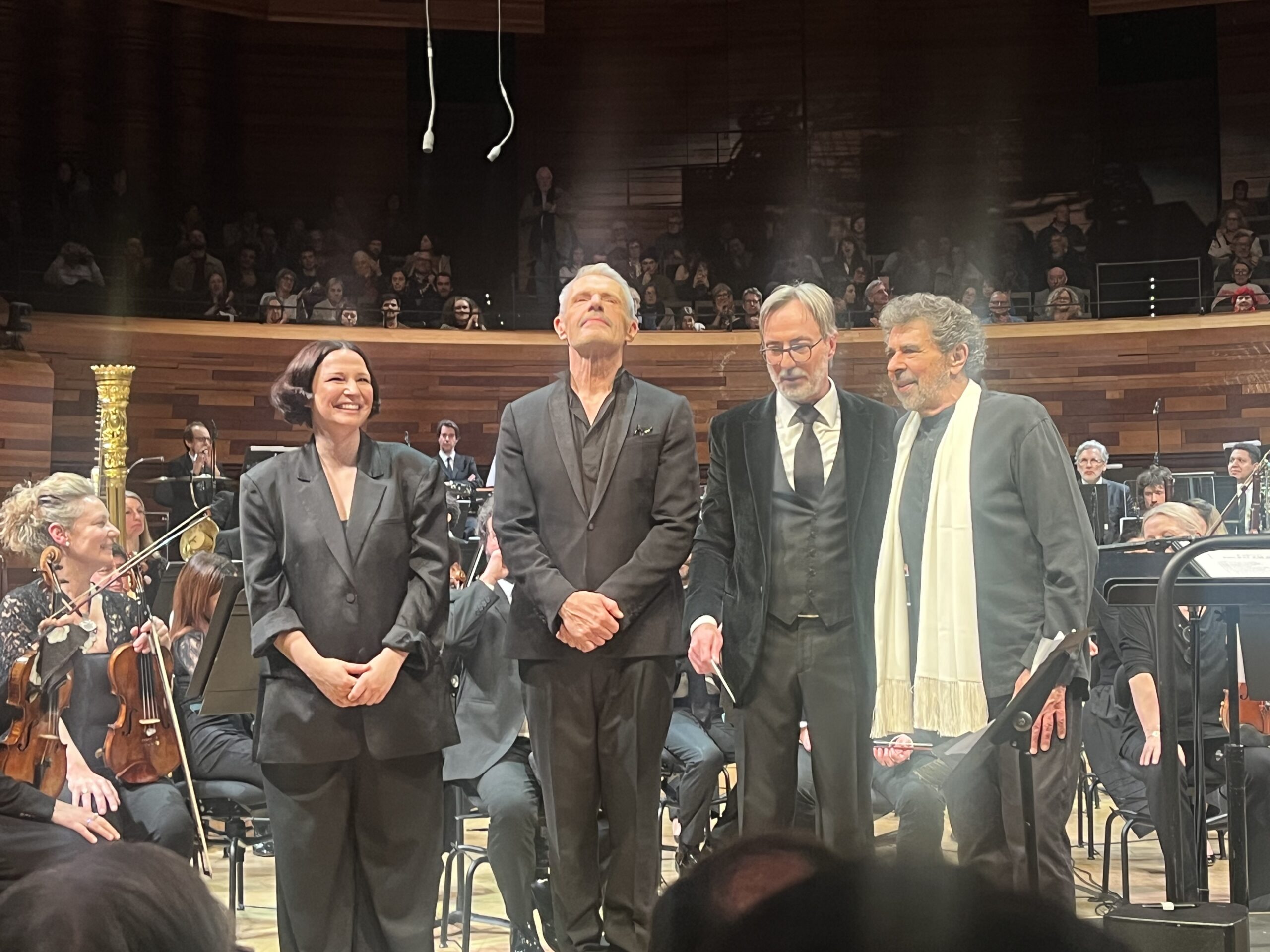
To bring this final piece to life, Wilson and Sila returned to the stage for a rapturous performance.

ENCORE
Les uns et les autres
(01:51:15 – 01:55:09)
– Ballet apocalypse
After a lengthy standing ovation, conductor Guiraud was beckoned back to the stage for an encore: a rollickingly fun performance of “Ballet apocalypse” from Les uns et les autres (English title: THE ONES AND THE OTHERS).
And that ended a wonderful evening with the music of Francis Lai.

PART 6: A STATE OF MELANCHOLIA
Outside of his native France, composer Jérôme Rebotier is relatively unknown which is a terrible shame because he is a tremendously talented composer best known for his work on the 2024 hit film, LE COMTE DE MONTE-CRISTO.

I had not heard about him or his music until a friend, who is a film music journalist, told me how great the score to MONTE-CRISTO was (read his excellent interview with Rebotier here). When I finally managed to listen to the score after picking it up on a visit to FNAC in Paris a year ago, I was simply blown away by the themes, the orchestration, and the vivid picture it was painting through its multifaceted music.
So when I found out that Rebotier would be premiering a new work at the Francis Lai concert, there was no reason for me to NOT attend the concert.
Winner of the 3rd France Musique – SACEM Audience Award for Film Music, Rebotier was commissioned by Radio France to compose a new piece of music to be premiered at the beginning of the Francis Lai concert.

This piece, which was titled “Melancholia,” has been described by Rebotier as showing “all the states one goes through when trying to write a piece, when one is initially overwhelmed by it, and then finally manages to find a kind of osmosis with the music.” He went on to say that “music is a kind of profound melancholia, at least that’s my starting point. It’s actually very broad; melancholy is a mixture of so many impressions and feelings: violence, euphoria, sadness, romanticism… all coming together to create this kind of incomprehensible feeling we call melancholy.” (source: Facebook; translation: Google)
“Melancholia” is a thematic, emotional and skilfully composed piece of music with a clear and compelling narrative. It’s easy to understand intellectually, and easy to appreciate in emotional terms.
As I do not have a background in music, I cannot explain the piece in musical terms so I will simply describe what kind of images listening to it conjures in my mind.
The piece opens with shimmering strings, immediately creating a feeling of caution. A lone violin then enters, bringing with it a sense of melancholy and dread for what lies ahead – and in the context of this piece, it is the need for the composer to compose music. Solo viola and then cello enter, adding to the melancholic and almost depressing mood. Percussion hits soon become heard, adding to the atmosphere which has now become tense and uncertain.
Then a mad rush of the orchestra – the composer is compelled to compose because he has a looming deadline. A strong and identifiable theme then emerges with choppy strings and percussion.
The piece continues with an undercurrent of melancholy. It soldiers on, becoming more filmic and epic in scope until there is a crash of the symbols.
There is a cascading effect with strings as the brass section play a powerful and epic theme.
The music (and composer) comes to a pause, but a solo violin soon returns, again with a sense of melancholy.
Frantic, uncomfortable music now dominates, with the cascading string figures returning supported by trumpets – the impression I get from the music here is that the composer begins to doubt his abilities – is this piece good enough? Do I have the talent to pull it off?
The tone now shifts to one of sympathy – those cascading strings return, yet in a much slower guise. A theme on oboe then makes its appearance sounding sympathetic and for the first time, hopeful.
My favourite part of the entire piece follows with a melody full of optimism and hope that builds to a climax. It feels as if a solution has been found and the composer can now move forward.
But uncertainty creeps back and swirling strings create a sense of panic and unease.
Yet that optimistic theme starts to shine through in fragments, overcoming the uncertainty while the music becomes more hopeful as it slows in pace.
Again, the music/composer pauses, followed by those cascading strings sounding more positive and hopeful than before.
Progress is being made and the composer is almost there – success is within sight and the percussion is driving that feeling forward.
The brass then play a theme that is both positive and hopeful, and the piece seemingly comes to an end – or does it?
A sudden mad rush to the end follows with a satisfying crescendo to finally conclude the piece – he did it! The composer has completed his work.
As mentioned at the outset, “Melancholia” is a thematic, emotional and skilfully composed piece of music with a clear and compelling narrative. My above description of it more than proves that.
I for one cannot wait to hear what Rebotier does next!
PART 7: WHEN DREAMS COMES TRUE
Through a mutual friend, I was extremely fortunate to able to meet Rebotier and Yared briefly before and after the concert. To say that this was an unforgettable experience is truly an understatement.
Both composers generously gave me their time, answered my many questions, posed for a photo, and were even kind enough to sign an item for me.


But the main impression I walked away with is this: despite their tremendous success and fame, Rebotier and Yared are both incredibly humble and generous people – not just composers – who went out of their way to talk to this stranger (= me!) who had travelled a very long way to be there.
If you listen to their work, you can just HEAR that humility shining through their music which is honest, direct and deeply personal – and that is precisely why I gravitate towards and connect with their music so much.
Gentlemen, merci beaucoup 😊
PART 8: APPRECIATION
A million thank yous from here to the stars to “S” for helping me meet my musical heroes. For this fan, it truly meant the world to me.
Huge thanks also to my dear friend David-Emmanuel who not only introduced me to the wonder that is Jérôme Rebotier, but also helped with some translation from French to English. Check out his excellent interview with Rebotier here!
PART 9: OVER TO YOU
Did you go to this concert too? How did you like it?
And what did you think of my report? Feel free to comment below or reach out to me directly in the “Contact Me” section.